Our default option, Growth, returned 3.25% for the financial year to date. Unsettled markets during the March quarter contributed to a return of -2.03%. Our pension default option, Balanced delivered 2.91% for the financial year to date and -1.55% for the quarter. Both options continued to meet their long-term investment objectives, helping members stay ahead of inflation over the longer term.
Source: Rest, 31 March 2026. Returns are net of investment fees and tax, except Pension, which is untaxed. The earnings applied to members’ accounts may differ. Returns for periods greater than one year are annualised. Past performance is not an indicator of future performance. Inception dates are 1 July 1988 for Growth and 13 September 2002 for the Balanced (Pension) option.
Source: Rest and FactSet, 31 March 2026. Returns are net of fees and taxes.
What happened over the March quarter?
It was a challenging quarter for share and bond markets. The Middle East developments, oil supply disruptions and expectations of higher interest rates contributed to uncertainty, alongside ongoing questions about the pace of AI change. Let’s have a look in more detail at the drivers and how markets responded.
AI disruption
In February, global software company share prices declined. There was heightened recognition that AI tools could make it easier for people and companies to build their own software, increasing competition and making it easier for new software companies to challenge established ones. As markets assessed which business models were most at risk from AI disruption, the technology sector experienced weaker performance over the quarter. While some companies bounced back, it is clear that not all business models will be resilient going forward.
This period highlighted an important point: AI disruption is a game changer and is creating a major long term shift. As with any new technology, impacts and outcomes will vary across companies and industries. In this environment, careful stock selection, deep analysis and a focus on investing in quality businesses is critical. This remains central to our investment approach at Rest: finding quality assets and building resilient all weather portfolios that are designed for all market conditions.
Middle East conflict, oil and inflation
Developments in the Middle East triggered disruption to one of the world’s largest oil supply routes, contributing to increased uncertainty.
The supply disruption led to higher prices and placed upward pressure on fuel and transport costs. Sustained higher prices may add to inflationary pressures which, in turn can impact share markets. As a result, concern over the growth outlook contributed to weaker global share markets over March.
Thoughts and outlook
The situation in the Middle East remains uncertain. A relatively fast resolution is likely to see markets stabilise, although oil prices may take some time to ease as supply is normalised. This scenario would support a more favourable growth outlook.
If the situation persists, higher interest rates for longer could slow global economic activity. Given these uncertainties, we expect market volatility to remain for the near term.
When investing, it’s important to recognise the difference between short term cyclical changes, such as oil price movements, and long-term structural changes such as AI disruption. This helps us position the portfolio to take advantage of both – to avoid losses, manage risks and find opportunities.
At Rest, we believe the investment landscape is entering a new phase shaped by multiple long-term forces. We believe that the era of low interest rates has ended and that interest rates are likely to remain higher. At the same time, AI is reshaping how economies grow and how people work—and it’s happening faster than expected.
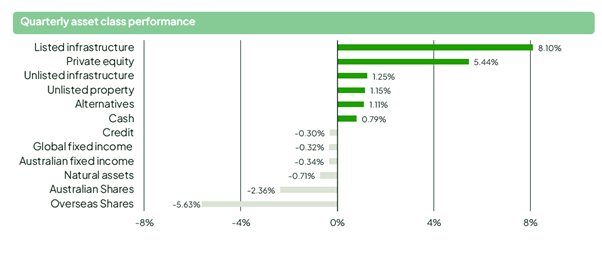
During periods like this, it’s important to remember that super is invested for the long term. While share markets normally move up and down in the short term, they have historically delivered strong returns over time. Diversification helps manage risk, as shown by the asset class returns in the graph. Our unlisted assets, including private equity and infrastructure performed strongly over the quarter and helped offset returns from shares and bonds.
Our investment team continues to monitor global markets and risks and opportunities. While we understand that market downturns can feel unsettling, they are a normal part of investing, and our team has successfully managed many periods of volatility before. We also know that these periods provide an opportunity for Rest to invest in high quality assets at more attractive prices, setting the portfolio up well for the future.