
happy man wearing a white shirt

Where will my money come from when I retire?

September 30 2026
Loading...
Information circle

Your retirement income might come from a few different places such as your super, investments, part-time or casual work, and the Government Age Pension. Find out how different sources of income can work together to fund your retirement lifestyle.
Possible sources of income in retirement

1. Super

Super is a significant source of retirement savings for most Australians. Once you’re eligible to access it, you have options for how to use your super to set up your retirement income.

For example, you could:

  • open an account-based pension (such as Rest Pension) to receive regular income payments from your super
  • make lump sum withdrawals from your super or pension account
  • use some of your super to purchase a fixed-term or lifetime annuity.

Learn more about Rest Pension 

2. Government Age Pension

The Government Age Pension is a fortnightly payment to assist with living costs in retirement. To qualify, you must be 67 or older and your income and assets must be below the limits set by the government.

You don’t automatically receive the Government Age Pension if you’re eligible – you need to apply for it.

How to apply for the Age Pension  

3. Non-super investments

Any money you have in savings accounts, shares, managed funds or investment properties can provide you with income in retirement. This income usually comes in the form of interest, dividends, distributions, rent or sale proceeds. 

4. Part-time or casual work

Many Australians are choosing part-time or casual work in their 60s, 70s and beyond. It’s a way to earn extra money to supplement other sources of retirement income, and it can also provide a sense of purpose and connection. There’s no age cut-off for super contributions from your employer, so these will continue while you’re working.

Learn more about returning to work after retirement

5. Home equity

If you’ve owned your home for at least 10 years and want to sell it, you may be able to use a strategy called a ‘downsizer contribution’ to boost your super. This is a one-off contribution using some of the money from the sale of your property. You must be at least 55 to use this strategy and you can use the proceeds from the sale to contribute up to $300,000 to your super.

Another way to use your home equity is by applying for a government loan called the Home Equity Access Scheme. It uses the equity in your home as security for the loan.

Learn more about downsizer contributions

Learn more about the Home Equity Access Scheme

6. Other government benefits

You may be eligible to receive government benefits that provide discounts or concessions. Depending on where you live and whether you’re receiving the Government Age Pension, this could include:

  • Commonwealth Seniors Health Card
  • Pensioner Concession Card
  • Seniors Card

See what government benefits are available

Income layering

Many people find they spend more money in the early years of their retirement and less as they get older. Using a strategy called ‘income layering’ may help you adjust your income throughout your retirement as your expenses and needs change.

There are three general categories that your sources of income may fall into:

  • Guaranteed income: Sources of income that you expect to remain consistent and last your lifetime. This might include Government Age Pension payments, other government benefits, or lifetime annuity payments.
  • Flexible income: Sources of income that you can generally increase or decrease according to your needs. They may provide income for a set time period, or until your balance runs out. This might include payments from an account-based pension (like Rest Pension), or fixed-term annuity payments.
  • Extra income: Sources of income that may be inconsistent or one-offs. This could be part-time or casual work, income from investments outside of super, or proceeds from selling assets.

Everyone’s retirement looks different. You may not have all three layers, and some of these sources of retirement income may not apply to you. 

Case study: Annie uses income layering to fund her retirement

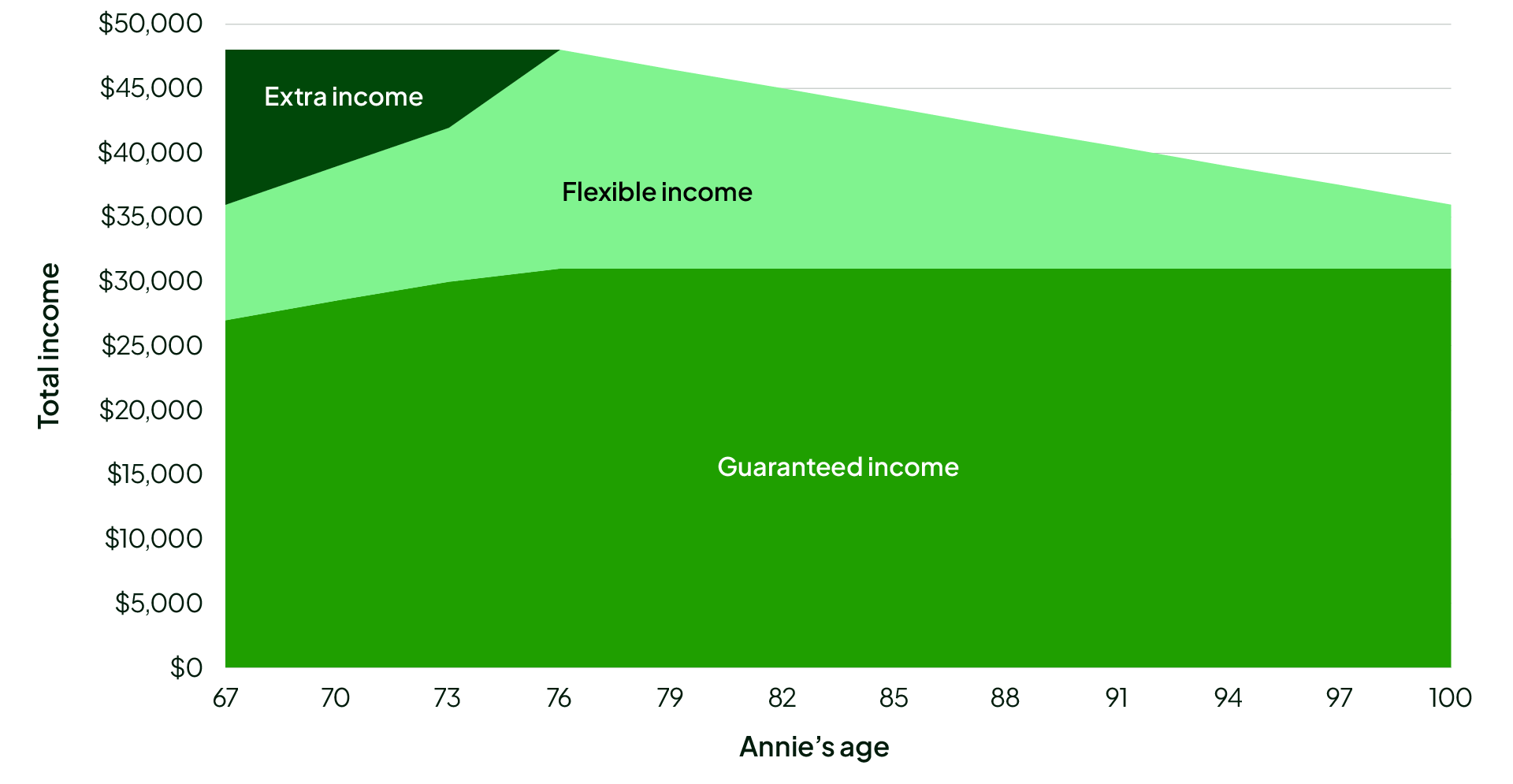
Retired nurse Annie is 67 years old. She estimates that she needs around $48,000 of retirement income each year at this stage of her life. Annie expects her income needs to reduce as she gets older.

Annie sets up her retirement income with a mix of guaranteed, flexible and extra income.

Guaranteed income: Age Pension payments from the government. To start with, Annie receives a part pension. She receives a full pension after she stops earning extra income.

Flexible income: Regular payments from her Rest Pension account. As Annie’s extra income reduces, she increases her Rest Pension payments to maintain her retirement income.

Extra income: Casual work as a first aid instructor. Annie works less as she gets older and eventually stops working entirely.

graph showing retirement income layering

Watch: Rest Retirement Income session

Get advice

Our Super Specialists can help you understand your options and structure your retirement income to meet your financial goals and needs.

This page contains information which may include general advice but does not take into account your individual objectives, financial situation or needs. We recommend seeking advice prior to acting on the options above. 

Want to learn more?